
Payooo guide
Debt Snowball vs Avalanche: A Calculated Example and Real-World Limits
Compare Snowball and Avalanche on identical balances, rates, minimums and a $200 budget, with first-payoff milestones and total modeled interest.
Payooo is for planning and tracking. It is not financial advice.
Snowball directs extra money to the smallest balance; Avalanche directs it to the highest-rate balance. Compare them with the same total budget and assumptions. Otherwise a result may reflect paying more money, not the strategy itself.
- Cover each modeled required payment before allocating extra.
- Hold starting balances, rates and total payment capacity constant.
- Compare the first balance cleared as well as total interest.
- Recheck account terms before treating a model's order as an instruction.
The CFPB debt-action plan describes both approaches and their tradeoffs. A smaller early payoff can make progress visible, while a higher-rate target focuses on cost. Neither is a personal recommendation, and the worked calculation below is not a comparison of lender offers.
Set identical inputs and rounding rules
Use two fictitious USD debts: A starts at $400 with 12% APR and a fixed $25 monthly minimum; B starts at $1,000 with 24% APR and a fixed $40 minimum. The total monthly payment budget is $200, initially leaving $135 above the combined minimums.
For each month, interest is opening balance times decimal APR divided by 12, rounded to cents per debt. Then pay the assumed minimums and send the remainder to the chosen target. Cap each payment at balance plus interest and redirect unused money to the other debt in the same month.
Rates and minimums remain fixed while balances are outstanding. There are no fees, new purchases, promotional changes or daily-balance calculations. These are simplified monthly model periods, not actual card billing cycles or a promised payoff date.
Example: compare allocation and results
Month 1 interest is $4 on A and $20 on B for either strategy. Snowball pays $160 to A and $40 to B, ending at $244 and $980. Avalanche pays $25 to A and $175 to B, ending at $379 and $845.
- Snowball clears one balance four modeled months earlier.
- Avalanche incurs $18.26 less modeled interest.
- Both finish in month 8 because the final payment is smaller, not because costs are identical.
| Result | Snowball | Avalanche |
|---|---|---|
| Initial target | A: $400 at 12% | B: $1,000 at 24% |
| Monthly budget | $200 | $200 |
| First balance cleared | A in month 3 | B in month 7 |
| All balances cleared | Month 8 | Month 8 |
| Total modeled interest | $115.42 | $97.16 |
| Total modeled payments | $1,515.42 | $1,497.16 |
Interpret the difference without overstating it
This example isolates order. It does not measure motivation, predict whether someone keeps paying or prove the same saving for another household. Reducing the monthly budget after clearing the first debt would change the comparison.
A larger rate gap or different balance sizes can produce a different cost difference. Do not reuse the $18.26 figure as a general benefit. The companion one-month worksheet helps inspect one period but does not generate this full multi-month comparison.
Recognize when an ordinary APR sort is incomplete
A promotional deadline, deferred-interest condition, prepayment fee or urgent overdue obligation may require a different analysis. A 0% balance about to change rates is not adequately described by today's rate alone. Check the agreement and ask the creditor about unclear terms.
Choose the order you can explain, keep required payments and essential costs in view, and review when inputs change. A custom order can record a real constraint, but calling it custom does not establish that it minimizes interest or resolves payment difficulties.
Inside the app
Payooo supports Snowball, Avalanche and other manual planning orders. Compare scenarios using the same inputs and treat the outputs as estimates. Its single-rate debt model does not reproduce every mixed-rate card or creditor allocation rule.
Free download with optional in-app purchases. See your store for current prices, subscriptions and terms.
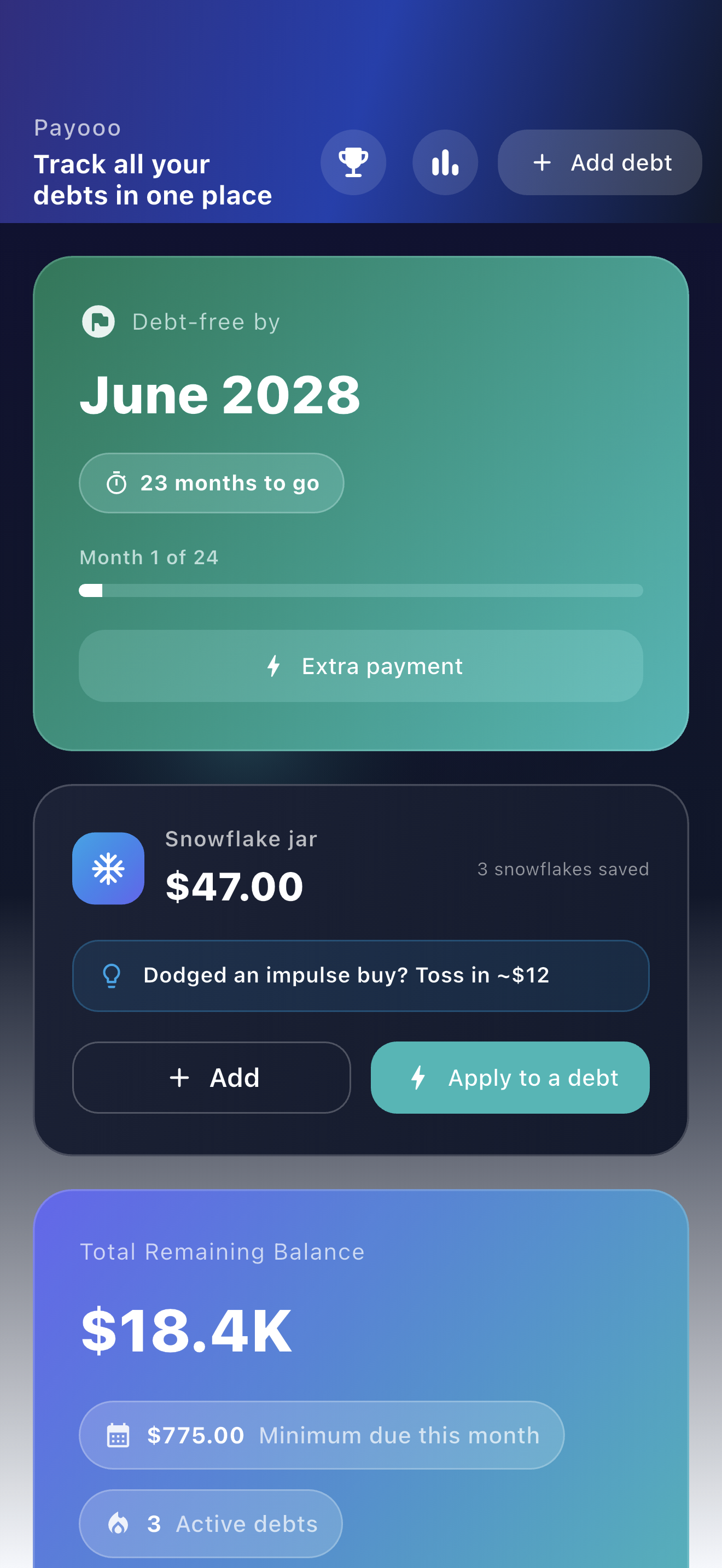
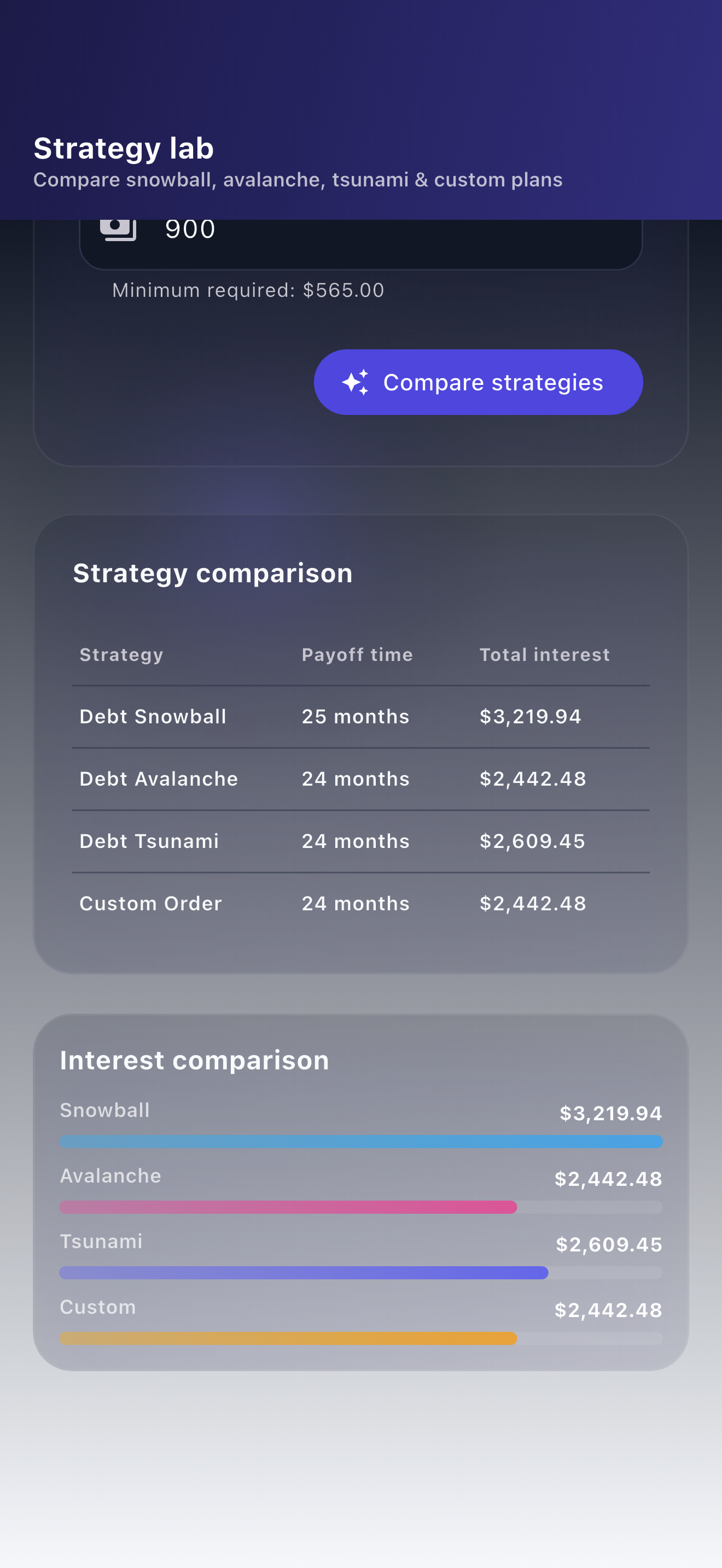
Compare cost and the timing of visible progress under the same budget. Then check whether your actual terms fit the model before choosing where extra money goes.
FAQ
Common questions
After required payments, Snowball targets the smallest balance and Avalanche targets the highest interest rate. Both need a feasible budget and account-specific checks.
No. The highest-rate approach has a cost rationale under comparable fixed-rate assumptions, but fees, promotions, deferred interest, allocation rules and changing payments can alter real outcomes.
Yes. In this article's fictitious example both finish in month 8, but Avalanche incurs $18.26 less modeled interest and Snowball clears the first balance sooner.
No. They are fixed assumed amounts for a controlled comparison. Real required payments can change; use your current statements.
