
Payooo guide
Extra Debt Payment Scenarios: Compare the Cost Before Sending Money
Compare two recurring extra-payment amounts against a baseline, with verified illustrative calculations and checks for cash flow and creditor terms.
Payooo is for planning and tracking. It is not financial advice.
Before sending extra money, check the target, the account's rules, the cash needed for other obligations and the assumptions behind the estimate. Comparing amounts is useful only when you know whether the extra is one-time or recurring.
- Name the account receiving the extra and why.
- Ask how additional payments are applied and whether charges apply.
- Protect essential costs and other upcoming required payments.
- Compare scenarios with the same opening balance, rate and timing.
The example below isolates one balance so the arithmetic is transparent. It is not an assessment of a real card or loan. Use creditor documents for actual interest and payoff quotes; the calculations here demonstrate a planning tradeoff rather than promise a result.
Specify the model before comparing outcomes
Assume a fictitious $2,000 balance, 18% annual rate and an $80 fixed monthly baseline payment. Interest is opening balance times 0.18 divided by 12, rounded to cents each month. Payments occur after that interest, with the final payment capped at the amount owed.
There are no fees, new purchases, missed payments, rate changes or daily-balance calculations. Each recurring extra starts in month 1 and continues until payoff. Months are model periods, not calendar-date predictions or a reconstruction of lender billing.
Example: $40 and $100 recurring extras
Month 1 interest is $30 in all three scenarios. The ending balances are $1,950, $1,910 and $1,850 respectively. Repeating the stated calculation until zero gives the following results, independently calculated for this article, not generated from Payooo app data.
- The $40 recurring extra reduces modeled interest by $206.73 versus baseline.
- The $100 recurring extra reduces modeled interest by $321.09 versus baseline.
- Neither saving describes the effect of a single extra payment.
| Recurring extra | Monthly total | Modeled payoff | Total interest | Final payment |
|---|---|---|---|---|
| 0 | 80 | Month 32 | 525.58 | 45.58 |
| 40 | 120 | Month 20 | 318.85 | 38.85 |
| 100 | 180 | Month 13 | 204.49 | 44.49 |
Check whether the real account behaves like this
For US auto loans, the CFPB distinguishes simple interest from precomputed interest; extra payments do not have the same effect under both. It also explains that prepayment penalties depend on the contract and state law. Do not apply one account type's rules universally.
Ask the servicer how much reaches principal, whether the due date advances and whether special instructions are needed. For a credit card, the issuer's daily balances and allocation among APR categories can differ from this single-rate monthly model.
Choose only after checking available cash
Compare the additional $40 or $100 with money actually available before the next income date. A recurring scenario needs recurring capacity; do not fund it by ignoring a known essential expense. Keep any one-time windfall separate from your continuing commitment.
If the payment fits, make it through the creditor or bank and retain evidence. After it posts, reconcile the balance before rerunning an estimate. The related one-month worksheet can help inspect one period, but it does not produce this payoff schedule.
Inside the app
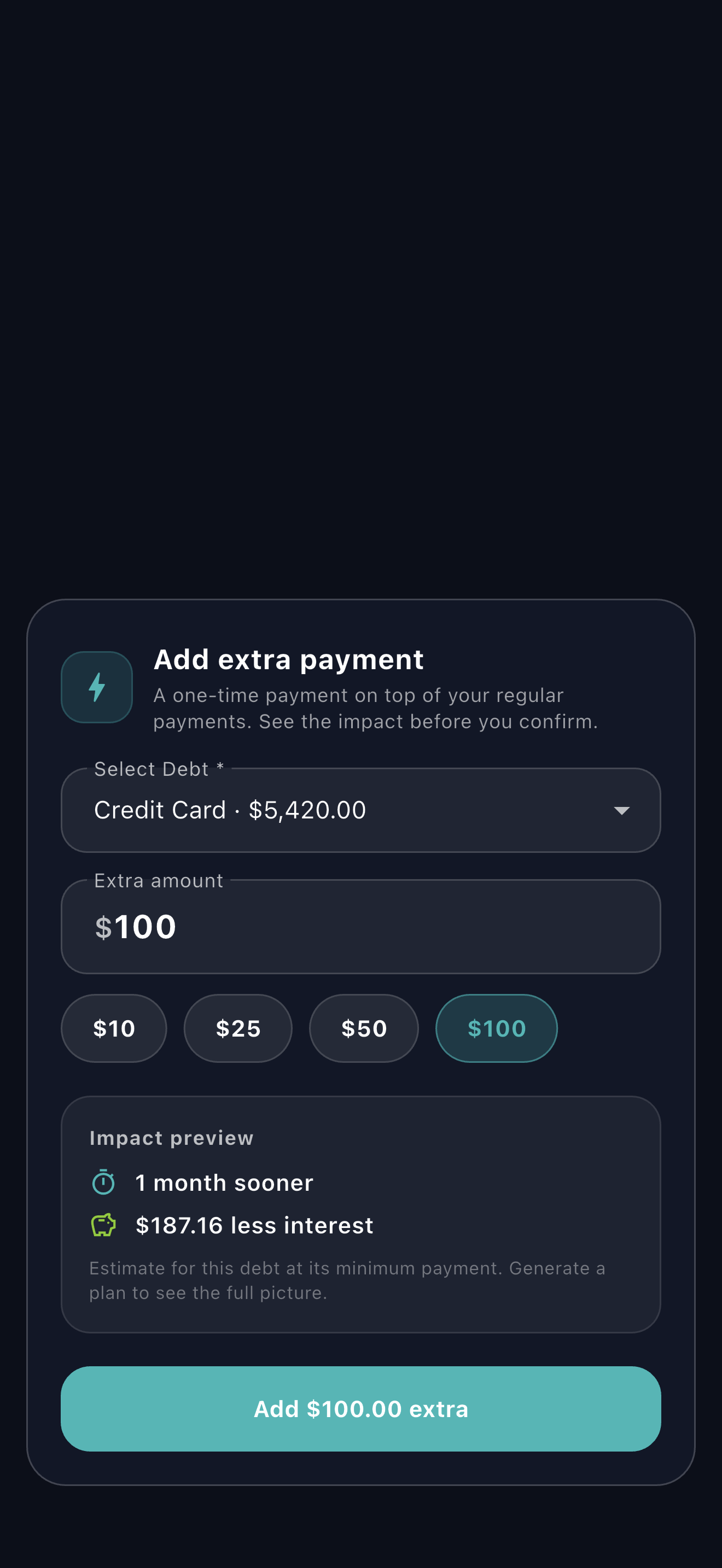
Payooo supports extra-payment previews and manual payoff scenarios. They are estimates based on entered assumptions, not creditor instructions or guarantees. Recording an extra payment in the app does not send it.
Free download with optional in-app purchases. See your store for current prices, subscriptions and terms.
Compare repeatable amounts under visible assumptions, then check the contract and the rest of the month. The largest modeled saving is not automatically the right payment for your circumstances.
FAQ
Common questions
No. Allocation rules, interest method, fees, payment timing and changes in account activity can alter the result. Ask the creditor how your specific account treats extra payments.
No. A recurring scenario assumes the additional amount is paid in every modeled month until payoff. A one-time payment changes only the period in which it is made.
No. That resource estimates a single period. The multi-month comparison in this article is a separate illustrative calculation under the stated assumptions, not a downloadable schedule calculator.
